

Tuesday, March 31, 2015


Tuesday, July 8, 2014
Not Even For a Minute
On a day that is just 72 degrees Fahrenheit, the temperature [inside a car] can increase by 30 to 40 degrees in an hour, and 70% of this increase occurs the first 30 minutes

Reduce the number of deaths from heatstroke by remembering to ACT.
A: Avoid heatstroke-related injury and death by never leaving your child alone in a car, not even for a minute. And make sure to keep your car locked when you’re not in it so kids don’t get in on their own.
C: Create reminders by putting something in the back of your car next to your child such as a briefcase, a purse or a cell phone that is needed at your final destination. This is especially important if you’re not following your normal routine.
T: Take action. If you see a child alone in a car, call 911. Emergency personnel want you to call. They are trained to respond to these situations. One call could save a life.
- See more at: http://www.safekids.org/heatstroke#sthash.EATF6gIV.dpuf video: http://www.safekids.org/video/simulation-rapid-and-extreme-car-heating-direct-sunlight
Top Tips
Reduce the number of deaths from heatstroke by remembering to ACT.
A: Avoid heatstroke-related injury and death by never leaving your child alone in a car, not even for a minute. And make sure to keep your car locked when you’re not in it so kids don’t get in on their own.
C: Create reminders by putting something in the back of your car next to your child such as a briefcase, a purse or a cell phone that is needed at your final destination. This is especially important if you’re not following your normal routine.
T: Take action. If you see a child alone in a car, call 911. Emergency personnel want you to call. They are trained to respond to these situations. One call could save a life.
- See more at: http://www.safekids.org/heatstroke#sthash.EATF6gIV.dpuf video: http://www.safekids.org/video/simulation-rapid-and-extreme-car-heating-direct-sunlight
Monday, November 26, 2012
Monday, October 29, 2012

Monday, October 22, 2012
Halloween: A Night for Treats, Not Tragedies
Halloween: A Night for Treats, Not Tragedies What You Need to Know to Keep Your Kids Safe on Halloween?  When it comes to preventing injury and keeping your kids safe on
Halloween we have found that repeated and consistent messages are the keys to
safety. When it comes to preventing injury and keeping your kids safe on
Halloween we have found that repeated and consistent messages are the keys to
safety.Our research reveals that parents may be placing their children in harm’s way by failing to talk to them each and every year about Halloween safety. Given children’s limited attention spans, as well as their ever-evolving cognitive abilities, you must review all the correct behaviors with your children to help them be safe. Make sure to review our safety tips before you headout trick-or-treating. Did you know that on average, twice as many kids are killed while walking on Halloween as compared to any other day of the year? Kids will be out while it is dark – making it harder for drivers to see them and because they’re excited about getting candy, they may not be watching out for cars. Parents and drivers both need to do their part to help kids stay out of the emergency room on Halloween. Emphasize safe pedestrian behaviors to kids before they go out trick-or-treating. Parents should also remember that costumes can be both creative and safe, so look for ways to use reflective materials. Drivers must slow down and watch out for trick-or-treaters, especially around crosswalks and driveways.
|
 Top tips to keep your kids safe on
Halloween
Top tips to keep your kids safe on
Halloween
Why Pedestrian Safety is Important
Walking Safely Tips
|
http://www.safekids.org/safety-basics/safety-resources-by-risk-area/pedestrian/why-pedestrian-safety-is-important.html
Up Coming Car Seat Check Up Events
November 1st
BH
Ambulance
We will have appointments from
9am-5pm, but extra appointments 11am-2pm

November
2nd
11am-2pm
November
6th
Kohl’s Department Stores (Kohl’s
Donation Announcement Event)
11am-3pm
November
8th
10:30am-1:30pm
Be Safe Halloween 2012
Holyoke Fire Department
Be Safe Halloween 2012
600 High St. Holyoke
2:00 to 6:00 pm

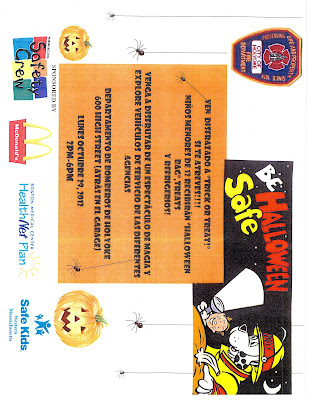
Be Safe Halloween 2012
600 High St. Holyoke
2:00 to 6:00 pm


Tuesday, October 16, 2012

Plan and Practice Your Home Fire Escape Plan
Plan and Practice Your Home Fire Escape Plan

During National Fire Prevention Week (October 7-13), Safe Kids Worldwide and the United States Fire Administration are teaming up to ask every family to create a home fire escape plan and to practice it with the entire family. We are working to raise awareness on fire safety all month long.
- Every day at least one child dies in a home fire. In that same day, 293 children suffer from a non-fatal unintentional injury caused by a fire or burn.
- Home fires account for nearly 90 percent of all fire-related fatalities.
- 77 percent of families have not developed and practiced a home fire escape plan, one of the most important components to surviving a home fire.
- Fire can spread rapidly through a home, leaving a family as little as two minutes to escape safely once the alarm sounds.
- Safe Kids and the United States Fire Administration are encouraging everyone to create and practice an at-home fire escape plan.
- Download our fire escape worksheet, in English or in Spanish. The worksheet provides a diagram to help children and parents work together to create and practice their own fire escape plan.
- http://www.safekids.org/safety-basics/safety-spotlight/plan-and-practice-your-home-fire-escape/
Saturday, April 7, 2012
Monday, January 30, 2012


Wednesday, January 4, 2012
Childproofing Your Home

That is equal to 8,219 injuries per day. Sadly, each day approximately six children die from injuries resulting from fires, burns, drownings, poisonings, choking, suffocation, strangulation and falls in the home.

Curious Kids
Young children are curious and don’t always understand what is dangerous. Have you asked yourself how your kids see your home? What looks interesting, and what can be reached? Drawers left open can easily turn into stairs to the TV! 
Limitations and Abilities
Understanding your child’s limitations and abilities is crucial. For babies, provide a safe sleep environment and protect them from falls and burns. Babies who can sit and crawl are also at risk of choking, poisoning, burns, falls and furniture tip-overs. Once your little one becomes mobile and begins to cruise around, childproofing becomes even more important.

Supervision and Modifications
While constant supervision is the most important safety precaution you can take, it’s sometimes not enough or possible. To create a safer home for your child, look for potential hazards and take steps to remove them before it’s too late. Outlet plugs, cabinet and drawer locks, window stops, window guards, furniture straps and brackets, smoke alarms, carbon monoxide (CO) detectors and stair gates are some of the low-cost safety devices you’ll need to get started.
Help your little ones explore their surroundings safely, knowing you have reduced the chances of serious injury.
http://www.safekids.org/safety-basics/safety-spotlight/childproofing-your-home/home-safety-checklist.html
http://www.safekids.org/safety-basics/safety-spotlight/childproofing-your-home/home-safety-checklist-safety-by-room.html
Carbon Monoxide - The Silent Killer

- Know the symptoms of carbon monoxide poisoning.
- The most common symptoms include headache, fatigue, nausea, vomiting, and confusion. In severe cases,the person may lose consciousness or die.
- CO poisoning can often be mistaken for other illnesses, such as the flu.
- Often, more than one person in the household will suffer symptoms at the same time.
- To decrease risk of CO poisoning the following tips are recommended:
- Install a CO alarm outside every sleeping area and on every level of your home.
- Place CO alarms at least 15 feet away from every fuel-burning appliance to reduce the number of nuisance alarms.
- Test alarms every month and replace them every five years.
- Make sure alarms can be heard when you test them and practice an escape plan with your entire family.
- Have all gas, oil or coal burning appliances inspected by a technician every year to ensure they are working correctly and are properly ventilated.
- Never use a stove for heating.
- Do not use a grill, generator or camping stove inside your home, garage or near a window.
- Never leave a car, SUV, or motorcycle engine running inside a garage, even if the garage door is open.
- CO can accumulate anywhere in or around your boat, so install a CO alarm on your motorboat.
- If your CO alarm goes off, follow these steps:
- Get everyone out of the house as quickly as possible into fresh air. Then call for help from a neighbor’s home or a cell phone outside of your home.
- If someone is experiencing CO poisoning symptoms, call 911 for medical attention.
- If no one is experiencing symptoms, call the fire department. They will let you know when it is safe to re-enter your home.
Wednesday, November 30, 2011

Christmas Tree Safety
Trim the Tree Safely
Trimming the tree is a traditional holiday pastime. However, if they are not properly cared for, Christmas trees can pose a serious danger. The Home Safety Council offers the following tips to keep in mind when selecting and caring for your Christmas tree this holiday season:
Turn off the lights when you leave the room or go to sleep.
Add water daily to keep your tree from drying out too fast.
Replace lights when they are cracked or the wire is frayed. Holiday lights should be replaced about every 3 years. Look for the UL label on the box so you know they have been tested for safety
http://www.homesafetycouncil.org/SafetyGuide/sg_holiday_w002.asp
- When buying a live tree, look at the needles. If they are brown or break easily, choose another tree. Test for freshness by bending a few needles in half. If the needles snap in two, the tree is dry - look for a tree with needles that spring back to their original shape.
- When you take your tree home, put it in a sturdy, non-tip stand filled with water.
- Give the tree plenty of water. Dry trees can catch on fire easily.
- Make sure the tree is at least three feet away from any flame or heat source.
- Never put candles on or near your tree.
- Put your tree near the electrical outlet. Do not block the exit.
- Before you put the lights on the tree, look at every bulb. If the string of lights does not look perfect, throw the lights away and get new ones.
- Lights do not last long. Replace your lights as soon as you see any signs of damage.
- Look on the box for a mark that says ETL, UL or CSA. This means the lights have been tested for safety.
- Read the directions. Only use as many strings of lights as it says is safe to use.
- When decorating indoors, use only those lights listed for indoor use. Unplug all lights, inside and out, before going to bed or leaving home.
- Safely get rid of your tree when it begins dropping needles. Dried-out trees are flammable. They should not be left inside the home or garage, or placed against the house.
- Make sure your home has working smoke alarms and fire extinguishers.
- Make sure your family knows what to do to get outside safely in a fire. Practice a family fire drill so your family and guests know the plan.
When finding and caring for your Christmas tree this holiday season, just remember the word "STAR":
Space: Keep your tree at least three feet away from any heat source or flames such as candles and fireplaces.
http://www.homesafetycouncil.org/SafetyGuide/sg_holiday_w002.asp
Tips for Holiday Electrical Safety
Holiday lights help make the season beautiful. They can also cause home fires. To keep your family safe:


Hang or mount light strands carefully to avoid damaging the cord's insulation

Do not plug in too many things at one time. Use a surge protector.
- Unplug all holiday lights when you go to sleep or leave home.
- Plug outdoor decorations into outlets protected by Ground Fault Circuit Interrupters (GFCIs) to prevent shock.
 Automatic lighting timers can be used to ensure that lights are not left on by mistake. These are available for both indoor and outdoor use.
  Do not put electrical cords under rugs. Try to keep them away from places people walk.
  When replacing a holiday bulb, be sure to use the correct bulb size (wattage) that is right for the fixture.
  Use safety caps to keep children from putting things into electrical receptacles/outlets.
 Tuesday, November 15, 2011
Rear-Facing – The Facts and the Myths CPS CEUS
Rear-Facing – The Facts and the Myths
Join us for a Webinar on December 8
Space is limited.
Reserve your Webinar seat now at:
https://www2.gotomeeting.com/register/574025522
The enhanced protection provided by rear-facing child restraints has been known for years in technical circles, and the body of evidence supporting an extended rear-facing period is growing. Authoritative bodies like the AAP and NHTSA have consistently expanded and reinforced their recommendations for keeping children facing the rear longer with each revision of their positions, and the maximum limits of many child restraint models have followed suit. Nevertheless, most children are faced forward long before they reach those limits, and generalizations about how rear-facing child restraints should be installed and used continue in the advocate arena.
This session looks at the facts about rear-facing child restraints, along with some of the educational issues that need to be updated, corrected and refined. Attendees will receive:
- Awareness of recent research on rear-facing effectiveness
- A better understanding of how rear-facing child restraints perform
- A better understanding of injuries reduced by longer rear-facing use
- A better understanding of child restraint installation and usage techniques that can reduce the need for foam noodles and locking clips
- Awareness of features that may enhance rear-facing protection
Dorel Juvenile Group and Safe Ride News are proud to sponsor this webinar in partnership with Joseph M. Colella, Child Passenger Safety Instructor from Traffic Safety Projects. By participating in this webinar, you are eligible to receive one CEU credit towards your Child Passenger Safety Technician or Instructor certification.
Joe Colella is a nationally respected consultant, speaker, instructor, correspondent and advocate. Since becoming involved in occupant protection advocacy, he has worked on improvement and educational efforts with many national organizations. He was also one of the original certified instructors for the National Standardized CPS Training Program, is a past Chairman of the National CPS Board, and has personally helped with education in 45 states.
Title:
Rear-Facing – The Facts and the Myths
Date:
Thursday, December 8, 2011
Time:
4:00 PM - 5:00 PM EST
After registering you will receive a confirmation email containing information about joining the Webinar.
System Requirements
PC-based attendees
Required: Windows® 7, Vista, XP or 2003 Server
Macintosh®-based attendees
Required: Mac OS® X 10.5 or newer
Join us for a Webinar on December 8
Space is limited.
Reserve your Webinar seat now at:
https://www2.gotomeeting.com/register/574025522
The enhanced protection provided by rear-facing child restraints has been known for years in technical circles, and the body of evidence supporting an extended rear-facing period is growing. Authoritative bodies like the AAP and NHTSA have consistently expanded and reinforced their recommendations for keeping children facing the rear longer with each revision of their positions, and the maximum limits of many child restraint models have followed suit. Nevertheless, most children are faced forward long before they reach those limits, and generalizations about how rear-facing child restraints should be installed and used continue in the advocate arena.
This session looks at the facts about rear-facing child restraints, along with some of the educational issues that need to be updated, corrected and refined. Attendees will receive:
- Awareness of recent research on rear-facing effectiveness
- A better understanding of how rear-facing child restraints perform
- A better understanding of injuries reduced by longer rear-facing use
- A better understanding of child restraint installation and usage techniques that can reduce the need for foam noodles and locking clips
- Awareness of features that may enhance rear-facing protection
Dorel Juvenile Group and Safe Ride News are proud to sponsor this webinar in partnership with Joseph M. Colella, Child Passenger Safety Instructor from Traffic Safety Projects. By participating in this webinar, you are eligible to receive one CEU credit towards your Child Passenger Safety Technician or Instructor certification.
Joe Colella is a nationally respected consultant, speaker, instructor, correspondent and advocate. Since becoming involved in occupant protection advocacy, he has worked on improvement and educational efforts with many national organizations. He was also one of the original certified instructors for the National Standardized CPS Training Program, is a past Chairman of the National CPS Board, and has personally helped with education in 45 states.
Title:
Rear-Facing – The Facts and the Myths
Date:
Thursday, December 8, 2011
Time:
4:00 PM - 5:00 PM EST
After registering you will receive a confirmation email containing information about joining the Webinar.
System Requirements
PC-based attendees
Required: Windows® 7, Vista, XP or 2003 Server
Macintosh®-based attendees
Required: Mac OS® X 10.5 or newer
Monday, November 7, 2011

Subscribe to:
Posts (Atom)
